Excess All Areas: art exhibition
Updated: Aug 5

Toy penguins crowd on a thong – together, but not a set – looking ahead. They are washed up. Surfing Penguins (2020–2026) stands on a plinth at the entrance and sets the tone: colourful and fun, yet disconcerting. The gallery echoes with excited kids and adults talking. Excess All Areas presents found objects, repurposed materials, and digital collage that charm us and prick our conscience. Remember this? The artists are smiling at us. And this, and this, and this?
The New Quotidian Collective was formed during COVID in 2020 by Lone Veirup and Mick Keast. The partnership is both personal and professional: they share a home, a sense of humour, art theory, and art making.
Mick Keast graduated with an honours degree in fine arts at QUT in 2017, where he began to embrace the art of the ‘quotidian’, or everyday life. Influenced by the Situationist Internationale’s critique of capitalism and its colonisation of the everyday, the New Quotidian practice reclaims public spaces through the dérive (walking aimlessly) and détournement (using the tools of what you are criticising to criticise it).
Lone Veirup is in her final year of a Bachelor of Visual Art at Queensland College of Arts and Design and is committed to bringing the Collective’s art to an audience. Initially, the Collective invited an audience of friends and acquaintances to in-home happenings, and they first exhibited to the public at Griffith University in 2025. This show at Caboolture Hub Gallery is their second public exhibition. All the works in the exhibition are attributed to the Collective.
The Hub Gallery is a compact community gallery flooded with the light and bold colours of Excess All Areas. There are two main exhibition spaces – the installations through the window on the left, and the digital collage prints through the wide entrance.
A colourful dress faces the window. It is patchwork– with sleeves extended wide – made of wrappers, shiny and rumpled, yet skilfully shaped to the human form. The work is titled Fast Food Fashion (2025) and made from branded plastics fiercely machine stitched together in white zig zag with loose threads left hanging. The neckline is made of red Kit Kat patchwork and edged with small blue Mentos wrappers. The diamond-shaped place where breasts might be is a pair of bright green Thins packets. The train fans out behind along the floor, made of glossy purple chocolate wrappers - Twirl, Dairy Milk, and Crunchie.
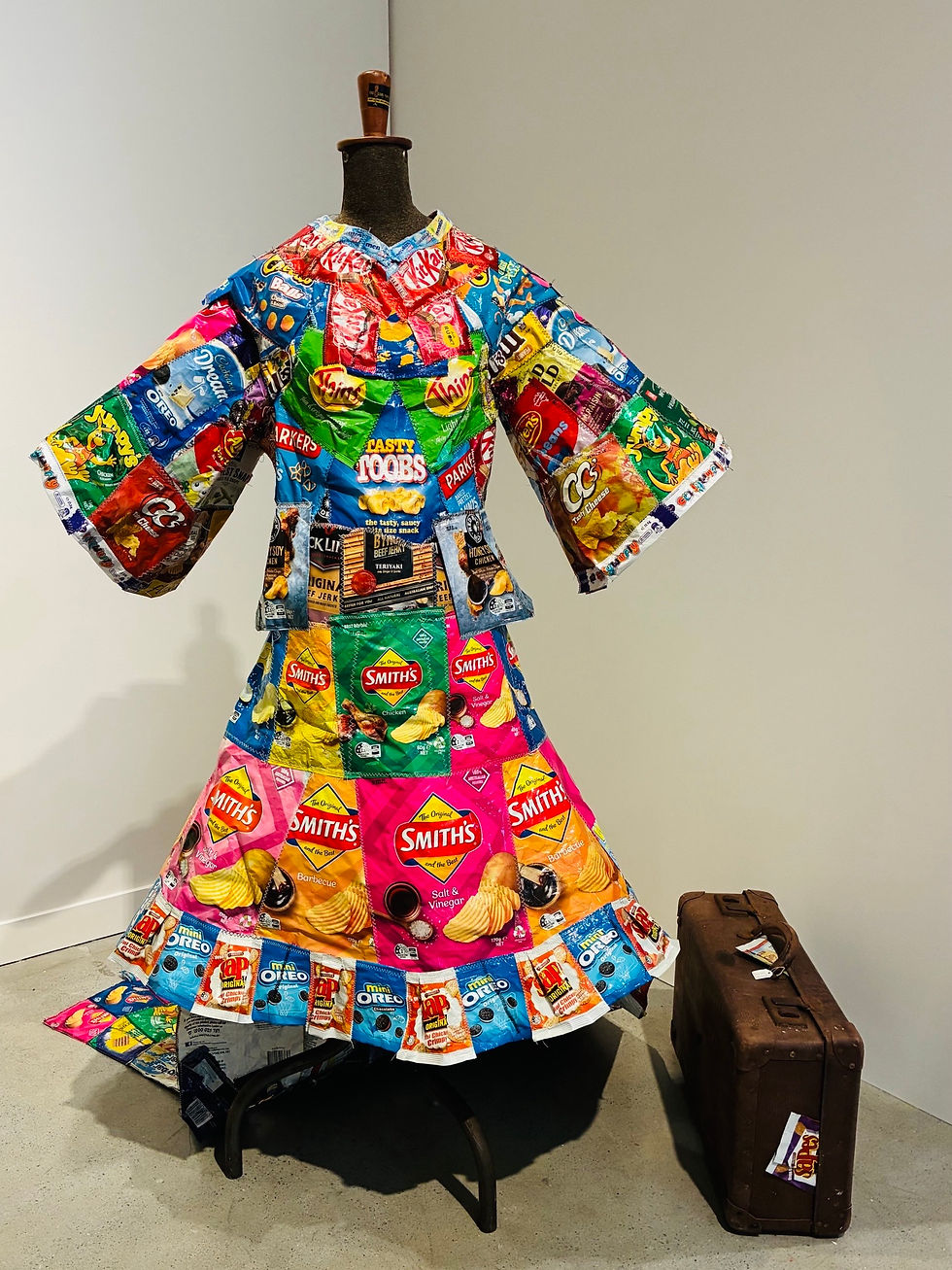

This work evokes a woman on her way to a festival - and presents a figure of celebration and confrontation. The familiar wrappers summon our endless appetite for fast food and take aim at the industry that brands and packages it, while the dense zig zag stitching around every piece transmits fury at so much waste. Australia uses more than 70 billion pieces of soft plastic a year, and most ends up in landfill or blows into streets and waterways. Lone Veirup was first inspired to make works from found wrappers in 2022, when Australia’s REDcycle soft plastics recycling scheme collapsed after a warehouse fire revealed the plastics were being stockpiled rather than recycled.
The New Quotidian Collective practise the dérive, finding discarded objects in parks and along roadsides. Mick Keast has collected objects over the past decade walking around Mitchelton, the northern Brisbane suburb where the artists live. They “walk down to Kedron Brook, along the bike path and back behind Brookside. The same route every morning. And then... there were just different loops out around the back around the hills, just loops, like a clover.”
For this exhibition Mick Keast caught the train to Caboolture and walked the public spaces in search of materials. He found a few objects for the installation Picnic (2026): a set of fortune cards strewn over a pedestrian bridge, and a new looking $30 scratchie ticket on a park bench in Centenary Lakes Park. Mick Keast said, “The scratchie threw me because it was sitting on the park bench with the 20¢ still there...I worked out they scratched the little bar at the bottom, and so they were just doing the fast track...And that perhaps speaks to some of the locals who are just desperate for a win.”

Despite numerous excursions to Caboolture, Mick Keast didn’t find many objects for the exhibition. “We would have liked to have found more interesting objects. Interesting objects were not too common.” This prompted questions for the artists about life in Caboolture and people’s use of parks and public spaces.
In the gallery space inside the entrance, three colourful drapes fill the room while A1-sized prints line the walls. The drapes are arranged one behind the other – diaphanous, moving gently in the air as people pass. Each drape is dedicated to one object: XXXX Gold (2026) for the giant stubbie holders, Tomato Sauce (2026) for the barbecues, and VB Green (2026) for the thongs. The titles poke fun at iconic Aussie brands you might see around the BBQ while adopting their colours as part of the visual language.
The VB Green drape features thongs printed on green sheer fabric, drifting from one direction to another, thongs in pairs and alone, thongs floating with formlessness. It is a restful work – like lying on grass in the backyard, with bare feet, looking up at the sky.


The A1 prints that line the walls are bold, sometimes intricate digital collages on saturated colour backgrounds, each dedicated to one type of found object. The VB Green collage is busy, organic, and tightly worked. The thongs are so small they are hard to identify at first; each is multiplied and arranged in patterns like schools of fish travelling in currents of water, or the topographic lines on a map. The green space winding through the image – from top right to bottom left – is an imprint of the Caboolture River. The discarded plastic thongs evoke contoured land, while the river is made only from negative space – it does not exist without the thongs. It has me pondering for days.
Playfulness is an integral part of the way the New Quotidian Collective live and make art, lending colour and vibrancy to a serious subject. Their work acknowledges the absurdity of life – a system largely outside of our control – tapping into our joy but also our guilt and responsibility as consumers. The artists see their practice as part of an emerging discourse about un-serious eco criticism: the idea that humour is the best way to wake people up to their habitual consumerism and their contribution to waste. On exhibition visitors, Lone Veirup said, “I'd like them to leave with a smile on their face... and a seed planted in their mind. What are we doing?”

The Hub Gallery shares a busy reception with the Caboolture Regional Art Gallery and Caboolture Library – and people are drawn into Excess All Areas for a closer look. School holidays have just begun when I visit. Reception staff greet visitors and suggest how they might spend time, while a young security guard sits opposite, relaxed and watchful. Outside in the concrete plaza the kids’ playground is empty, a couple who were sleeping rough are packing up, and office workers are chatting over lunch.
Excess All Areas is built from the everyday objects we leave in public spaces – the toys a child throws from the pram, the thongs that have lost their mate. The New Quotidian Collective collect these castoffs and transform them into installations and digital collages that make us smile – and plant a seed. Nothing we consume goes away; everything we use still exists, just outside of our view.

Excess All Areas, The Hub Gallery, Caboolture, 27 June - 23 July, 2026
Instagram: @newquotidian


Comments